2nd Sunday of Advent
Ezekiel 37:1-14
The hand of God came upon me, and brought me out by the spirit of God and set me down in the middle of a valley; it was full of bones. I was led all around them; there were very many lying in the valley, and they were very dry.
God said to me, “Mortal, can these bones live?”
I answered, “O God, you know.”
Then, God said to me, “Prophesy to these bones and say to them: O dry bones, hear the word of God. Thus, says God to these bones: I will cause breath to enter you, and you shall live. I will lay sinews on you and will cause flesh to come upon you and cover you with skin and put breath in you, and you shall live, and you shall know that I am God.”
So, I prophesied as I had been commanded, and as I prophesied, suddenly there was a noise, a rattling, and the bones came together, bone to its bone. I looked, and there were sinews on them, and flesh had come upon them, and skin had covered them, but there was no breath in them.
Then, God said to me, “Prophesy to the breath, prophesy, mortal, and say to the breath: Thus, says our God: Come from the four winds, O breath, and breathe upon these slain, that they may live.”
I prophesied as was commanded, and the breath came into them, and they lived and stood on their feet, a vast multitude.
Then, God said to me, “Mortal, these bones are the whole house of Israel. They say, ‘Our bones are dried up, and our hope is lost; we are cut off completely.’ Therefore, prophesy and say to them: Thus says our God: I am going to open your graves and bring you up from your graves, O my people, and I will bring you back to the land of Israel. And, you shall know that I am God when I open your graves and bring you up from your graves, O my people. I will put my spirit within you, and you shall live, and I will place you on your own soil; then you shall know that I, your God, have spoken and will act, says our God.”
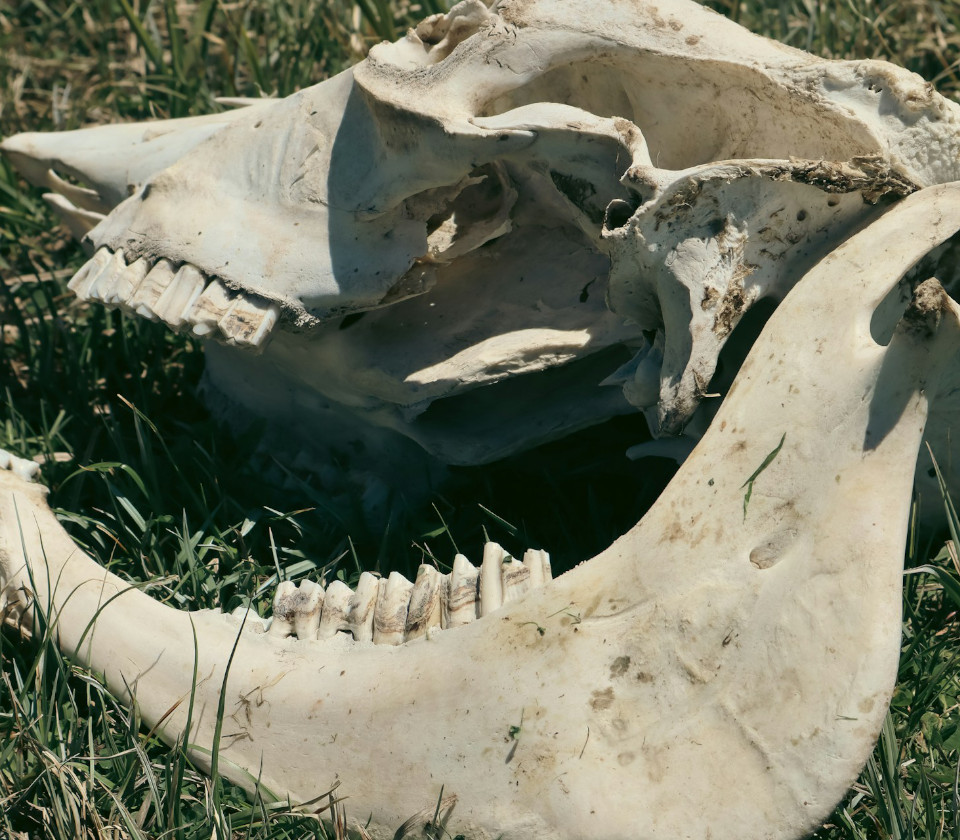
Valley of Bones
In 1889, the population of the American bison was a mere 541 animals. With an estimated population of 60 million at the end of the 18th century, systematic efforts to subjugate Native Americans by depriving them of one of their major resources, along with commercial hunting and the introduction of bovine diseases from cattle, nearly drove the largest animal in North America to extinction.
Our text today is The Valley of Dry Bones. The bones in this text are the bones of the Israelite people, but whenever I hear the phrase “valley of dry bones,” I can’t help but think of the pictures that I’ve seen of the mountains of bison bones from the slaughter of this magnificent animal of the American West. In one of the pictures, someone is standing on top of a mountain of bison skulls (just the skulls!) that’s almost forty feet tall! I can’t even imagine the effort it would take to collect and pile up that many skulls! And, why would someone waste so much time and energy to do such a thing?
I love animals, and I love nature, so stories like this are just appalling to me. We, as human beings, have done so much damage to our world, and it’s only been in recent years that we’ve truly begun to understand our dependence on the natural world, and how our actions affect it. There was a time when the concept of extinction was seen as a myth. People didn’t think that animals could go extinct. But then, species like the dodo bird and the passenger pigeon going extinct as a direct result of human action proved that such a thing could happen. And, we know it’s still happening today. In fact, it’s happening faster than ever before. Scientists estimate that as many as 150 species go extinct every day. That number includes a lot of undocumented species that we may never know about, but as far as plants and animals that we do know about, we know that we have lost 801 since the 1500s.
In much the same way that our text today is about the oppression of the Israelite people, the mountains and fields of bison bones tell the story of the oppression of our Native American siblings. And, the current destruction of life on this planet tells the story of how we are subjugating creation for ourselves.
Like many of the texts we’ve been looking at lately, Ezekiel was written during the time of exile. The Israelites were an exiled people, living far away from the land of their ancestors. They thought they were cut off from their God, who they believed was back in their homeland of Judah. They had no idea when or even if they would ever be able to go home, again. And so, Ezekiel was written as a message of hope.
This vision that Ezekiel has of the valley of dry bones is often used in conjunction with the resurrection of Jesus, so, like last week’s text with Shadrach, Meshach, and Abednego, we might be wondering why, on the Second Sunday of Advent, we are being given a story that’s usually tied to Easter.
In addition to that, we have to remember that when this prophecy was written, this valley of dry bones did not represent Jesus, the bones represented the entirety of the Israelite people. The bones represented their exile, their sadness, their separation, their hopelessness. The Israelites had been uprooted, they were unmoored, they were lost and abandoned. They thought of themselves as spiritually dead.
God brought Ezekiel to this valley of dry bones, and told him to prophesy over them. Ezekiel spoke to the bones, and the bones rattled. The bones drew together, held in place with sinew, muscle, and skin, but the bodies did not breathe. And, God told Ezekiel to prophesy to the breath, to speak to the breath. God told Ezekiel to tell the bodies that God was commanding the breath to come from the four winds so that the slain might live. “And the breath came to them, and they lived, and stood on their feet, a vast multitude.”
There’s a very interesting detail in this story that a lot of people might miss. Ezekiel was not a mere bystander watching God work. No, God told Ezekiel to prophesy over the bones. God didn’t just resurrect the bones; God told Ezekiel to tell the bones that God was going to resurrect them. God told Ezekiel to tell the bones that God would lay sinews on them, would cause flesh to come upon them, that God would cover them with skin, and put breath into them, and that they would live. That is how God works in the world. God works through us. This is what God has always done; God works through us, through our hands and feet, for we are the body of Christ, God’s hands and feet in the world. Just as Ezekiel is called to prophesy over the bones, we are called to spread God’s hope and love to the world.
And, while the bones might represent the Israelite people, if we take the long view, knowing that Christ is coming, knowing that God has a plan, that God is the same now, and always, and forever, then we can look at this story of Ezekiel and the valley of dry bones as a foreshadowing of what is to come. Just as God breathes life into the bones, Jesus is born into the world to breathe new life into us. In a time when it feels like everything is falling apart, when it seems like there’s no end in sight for the difficulties that we’re going through, when it seems like there’s no hope, when we are in the valley of dry bones, Jesus comes to bring us hope…to be the guiding light of hope for us, a beacon in the night, a safe harbor in the storm.
And, as we move through Advent and Christmas, as we wait with anticipation for the birth of Jesus into our world, with all of the joy and celebration that comes with that, we have to remember that there is no Christmas without Easter, and there is no Easter without the crucifixion. So, even though the story of valley of dry bones is told during Lent and Easter, it makes sense to tell it now, not only to help us understand how God comes into the world to bring healing and hope, but as a reminder that the resurrection is coming, and not just for Jesus, but for the world.
Resurrection would not have been some strange foreign concept to the Jews of the first century; they would have been familiar with the story of Ezekiel and the valley of dry bones. And, in the days leading up to the crucifixion, there would have been reports of Jesus raising people from the dead: the widow’s son, Jarius’ daughter, and Jesus’ own friend Lazarus. Death is no hardship for God. God’s breath brings what was dead back to life, and brings life to places where there was no life before. God’s breath brings hope to the hopeless.
I can only hope that as all of the bones pile up as species go extinct because of climate change and habitat loss that someday, God will breathe new life into those bones. Every time I hear about a species that’s nearing extinction, it’s like a gut-punch. I only recently learned about the vaquita porpoise, which lives in the gulf of California. A porpoise is similar to a dolphin. The vaquita porpoise is tiny; it grows less than five feet long, with a life expectancy of about 20 years. It’s really upsetting that I’m only learning about this animal when it’s on the brink of extinction. It’s estimated that there are currently less than 10 vaquita porpoises left in the wild. There are of course major efforts underway to save the vaquita, but attempts to raise it in captivity and breed it have failed, and with only 10 animals left, its chances are not good.
Which isn’t to say there is no hope. We almost lost the American bison, but today, there are over 30,000 of them. And, in 1987, there were only 22 California condors left in the world, all of them in captivity. Through breeding programs and conservation efforts, there are currently over 500 California condors, though many of them are in captive breeding programs. But, this came at a cost. The California condor conservation project was one of the most expensive species conservation projects in United States history, at over $35 million since World War II. But, the species is making a recovery. God is breathing new life into the world through people who care.
No matter how difficult or unbearable things become, we know that in the end, God will prevail, and that the breath of God will course through all of creation, setting things right, and bringing light and life to the desperate and the hopeless. Our God is a God of resurrection and renewal. And, we are a part of that renewal. God works in partnership with us and works through us. God’s breath is us, and when we breathe out God’s love to the people of the world, we become God’s breath, we become the gift of light and hope that God offers to those who need it the most, including the other species who share this planet with us. Amen.
~ Rev. Charles Wei

