

16th Sunday after Pentecost
Exodus 3:1-15
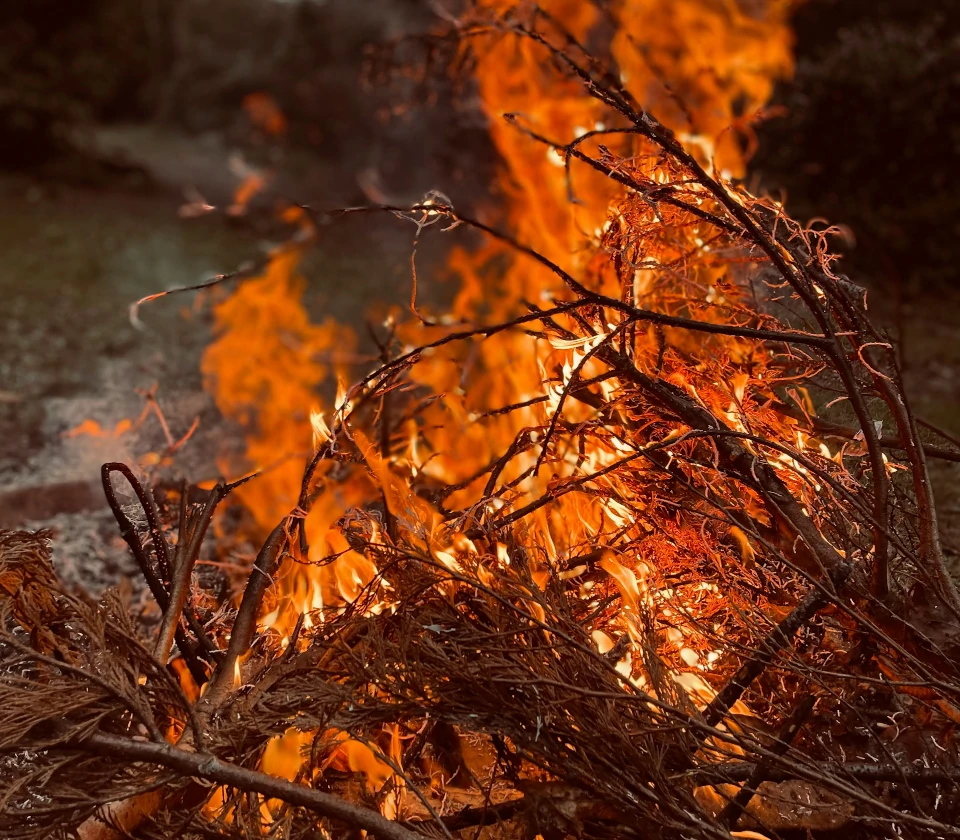
Moses was keeping the flock of his father-in-law Jethro, the priest of Midian; he led his flock beyond the wilderness and came to Mount Horeb, the mountain of God. There the angel of God appeared to him in a flame of fire out of a bush; he looked, and the bush was blazing, yet it was not consumed.
Then, Moses said, “I must turn aside and look at this great sight and see why the bush is not burned up.”
When God saw that [Moses] had turned aside to see, God called to him out of the bush, “Moses, Moses!”
And, [Moses] said, “Here I am.”
Then, [God] said, “Come no closer! Remove the sandals from your feet, for the place on which you are standing is holy ground. I am the God of your father, the God of Abraham, the God of Isaac, and the God of Jacob.”
And, Moses hid his face, for he was afraid to look at God.
Then God said, “I have observed the misery of my people who are in Egypt; I have heard their cry on account of their taskmasters. Indeed, I know their sufferings, and I have come down to deliver them from the Egyptians and to bring them up out of that land to a good and spacious land, to a land flowing with milk and honey, to the country of the Canaanites, the Hittites, the Amorites, the Perizzites, the Hivites, and the Jebusites. The cry of the Israelites has now come to me; I have also seen how the Egyptians oppress them. Now go, I am sending you to Pharaoh to bring my people, the Israelites, out of Egypt.”
But, Moses said to God, “Who am I that I should go to Pharaoh and bring the Israelites out of Egypt?”
God said, “I will be with you, and this shall be the sign for you that it is I who sent you: when you have brought the people out of Egypt, you shall serve God on this mountain.”
But, Moses said to God, “If I come to the Israelites and say to them, ‘The God of your ancestors has sent me to you,’ and they ask me, ‘What is God’s name?’ what shall I say to them?”
God said to Moses, “I am who I am. Thus you shall say to the Israelites, ‘I am has sent me to you.’ ” God also said to Moses, “Thus you shall say to the Israelites, ‘The God of your ancestors, the God of Abraham, the God of Isaac, and the God of Jacob, has sent me to you’:This is my name forever, and this my title for all generations.”
Remember
Once again, the lectionary has dropped us into the middle of a story, and looking ahead to next week, there’s going to be another big jump, skipping over a lot of it, so, let’s start with some context. I think most of you know the general gist of the Moses story, but just to make sure we’re all on the same page, the Israelites were enslaved in Egypt. Pharaoh wanted all of the Israelite males to be killed at birth, so that the Israelite population wouldn’t be able to challenge him. So, when Moses was born, his mother put him into a basket, and hid him in the reeds on the bank of the river. Pharaoh’s daughter found him, and claimed him as her own.
One day, when Moses was a grown man, he saw an Egyptian beating an Israelite, and so Moses killed the Egyptian. Moses ran away, because the Pharaoh wanted Moses to be killed for doing this. Which brings us to today’s reading. Moses is in the desert, and he sees a burning bush. And, God’s voice speaks to him from this bush. And, God says that the suffering of the Israelites has not gone unnoticed, and that Moses is to go to Pharaoh and demand that the Israelites be set free.
That is where our reading stops, but, as many of you know, Pharaoh refuses to release the Israelites, until God sends ten plagues upon the land: the water turns to blood, swarms of frogs, locusts, and flies appear, a hailstorm with fire! The tenth and final plague was the death of the firstborn. God had instructed the Israelite families to each sacrifice a lamb, and use its blood to paint the lintels of their doors so that the angel of death would pass over them. But, the Egyptians didn’t do this, and thousands of firstborn died across the land, and finally, Pharaoh said, “Enough! Take your people, and go!”
Six hundred thousand people left their lives of slavery in Egypt, but when they got to the Red Sea, they had no idea how to cross it. And, Pharaoh decided he had made a mistake, and took an army to bring the Israelites back. God parted the Red Sea, and the Israelites crossed on dry land. Pharaoh’s army tried to chase after them, but the waters came back, washing them away, and the Israelites were safe.
There are certain events in your life that have a way of sticking with you…formative events that become a part of who you are. Sometimes these events are fun and exciting, sometimes they’re traumatic, and sometimes they just stick to you, and you have no idea why. And, there’s no way to know how important they are, until the years have gone by, and you’ve grown, and you’ve changed, and the memories resurface at some later point in your life.
There was this one time, when I was really little, maybe 5 or 6 years old, and I was with this big group of people. We were all following this man who was wearing a long robe and he had this big staff that he used like a walking stick. And, he led us out to the water, and I remember hearing someone say that it was the Red Sea. And, I didn’t know at the time that something special was about to happen, but I wish I had, because I would have paid more attention. But, this man held his hand out over the water, and like magic, this channel just opened up, right through the middle of it, and he walked out onto the sand, and we all followed him.
It was so exciting, so weird and scary, stepping out onto that sand with these walls of water on either side. I couldn’t help but think that the water could come back at any moment. But, it didn’t. I had never seen anything like that before, and I don’t know if I’ll ever see anything like that again.
This, of course, all happened while I was at Vacation Bible School. After we all made it across the sandbox that the adults had turned into the Red Sea, we all went back to our class with our teacher, and had a snack, and then probably did some kind of art project.
When my parents picked me up that day, I told them about crossing the Red Sea, how Moses held his hand out and separated the water, and how we walked through with walls of water either side, and I could not wait to see what was going to happen the next day at Vacation Bible School.
That was over three decades ago. I like using this story to talk about communion, because of how the sacrament of communion rose up out of the events and the observation of the Passover. We aren’t celebrating communion today – we do that on the first Sunday of the month – but I’m going to be away at the Conference Annual Meeting next week, and this is the scripture that the lectionary gave us for today. As we always say on Communion Sunday, on the night that Jesus was arrested, he was celebrating the Passover with his family and his friends, to remember the time that their ancestors were rescued out of slavery in Egypt. The Passover, when each Israelite family sacrificed a lamb, so that they would be saved. The word sacrifice is always tied to communion, but when you grow up hearing something that’s just a part of everyday speech, it becomes normalized, no matter how significant that thing might be.
There’s a game you can play, where you take a word, any word, doesn’t matter what it is, and you just repeat it over and over again until it becomes just a sound, a sound without meaning. It’s called semantic satiation. When you keep saying the same word over and over again until it’s just a sound that’s completely divorced from the object or idea that it’s supposed to be referring to. Sometimes, when we talk about what Jesus did, it can seem like semantic satiation.
But, I remember the time when it stopped being just sounds, and I realized what it meant to take communion. The bread: Jesus’ body broken for us. Broken for us. His blood shed for us. Jesus was broken. These are words of pain…of dying. These are the words of sacrifice that Jesus made for us. He didn’t have to do it. But, he did it willingly, to save us.
These are the elements that we partake of on the first Sunday of every month. The meal that was forever transformed by the words Jesus spoke over 2,000 years ago. It was no accident that the Last Supper was a Passover meal…the Passover, which is so powerful in its symbology.
I was listening to a rabbi talking about the Passover one time, about its importance in the lives of Jews living today. He said that the Passover is not simply a remembrance; it’s not just a reminder of something that happened to their ancestors thousands of years ago. The Passover is their collective link to the events of that time, that when they eat the unleavened bread, they become the people who were brought out of Egypt. They don’t celebrate the Passover to remember the people that were freed. They celebrate the Passover because they are the people that were freed.
And, I don’t know why I never realized it before, but it suddenly dawned on me that this was the meal that Jesus turned into communion. He was celebrating the Passover with his family and his friends, and he took the bread, and he took the cup, and he told them to remember him after he was gone…that every time they ate the bread, and drank the cup, they were to remember him. That Jesus said this during the Passover was not an accident! The bread was already a symbol of freedom. Whenever they celebrated the Passover together, they were transported back in time, to a time when God came down with lightning and fire, and pushed the waters back so they could cross the Red Sea, to free them from slavery.
Only now, Jesus is saying that he is the bread. He is the cup. When we eat the bread, and drink the cup, we are remembering Christ’s death and resurrection, the sacrifice that he made for us to free us from the slavery of death and sin. And, we join with him in new life! Because, communion is still a celebration of the Passover. Whenever we partake of the bread and cup, we are transported back in time to claim our place among the people who were rescued out of Egypt. We are transported back in time to claim our place at the table of the first Communion, when Jesus told us that he was the bread and cup. These aren’t some distant events that happened thousands of years ago. They are happening right now, right here, every time we break bread, and thank God, and remember what Jesus did. Communion, baptism, the Exodus, the Passover, Jesus’ life, death, and resurrection, these are eternal, cosmic events, now, forever, and always.
When I think back to that day in Vacation Bible School, and I remember walking across the wet sand, I can’t help but get the sense that somehow, somehow, I really was there when it all happened. I was with Moses, walking through the Red Sea, between two walls of water. It’s like the bread and the juice of communion. I know it’s just bread and juice. But, it’s not just bread and it’s not just juice, because every time we share this meal, we take our place in the history of the salvation of God’s people. It’s our link to our past. It’s our link to each other. It’s our link to the future that God has promised for us. It is now, forever, and always.
Amen.
~ Rev. Charles Wei

