Ninth Sunday after Pentecost
Revelation 5:1-13
Then, I saw in the right hand of the one seated on the throne a scroll written on the inside and on the back, sealed with seven seals, and I saw a mighty angel proclaiming with a loud voice, “Who is worthy to open the scroll and break its seals?”
And, no one in heaven or on earth or under the earth was able to open the scroll or to look into it. And, I began to weep bitterly because no one was found worthy to open the scroll or to look into it.
Then, one of the elders said to me, “Do not weep. See, the Lion of the tribe of Judah, the Root of David, has conquered, so that he can open the scroll and its seven seals.”
Then, I saw between the throne and the four living creatures and among the elders a Lamb standing as if it had been slaughtered, with seven horns and seven eyes, which are the seven spirits of God sent out into all the earth. He went and took the scroll from the right hand of the one who was seated on the throne. When he had taken the scroll, the four living creatures and the twenty-four elders fell before the Lamb, each holding a harp and golden bowls full of incense, which are the prayers of the saints. They sing a new song:
“You are worthy to take the scroll
and to break its seals,
for you were slaughtered and by your blood you ransomed for God
saints from every tribe and language and people and nation;
you have made them a kingdom and priests serving our God,
and they will reign on earth.”
Then, I looked, and I heard the voice of many angels surrounding the throne and the living creatures and the elders; they numbered myriads of myriads and thousands of thousands, singing with full voice,
“Worthy is the Lamb that was slaughtered
to receive power and wealth and wisdom and might
and honor and glory and blessing!”
Then, I heard every creature in heaven and on earth and under the earth and in the sea and all that is in them, singing,
“To the one seated on the throne and to the Lamb
be blessing and honor and glory and might
forever and ever!”
Breaking the Seal
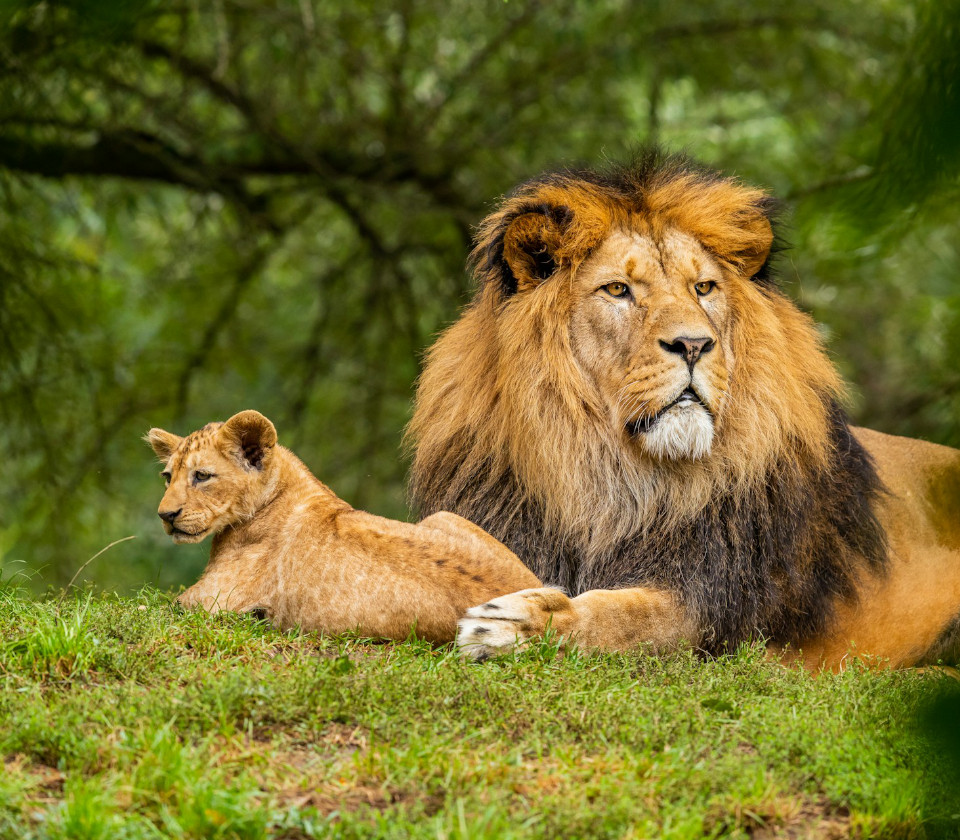
Here, in chapter five of Revelation, we continue our scene in the heavenly throne room. But now, there is a new character: the Lion…or is it the Lamb? We have more of that language of symbols that we need to figure out if we’re to get any kind of understanding from these writings.
A lion is a conqueror; a lion is ferocious! The Lion is a symbol of a king. But, a Lamb, standing as though it had been slaughtered, no-less, is a symbol of the meek and the conquered. But, this Lamb has seven horns and seven eyes, and we remember from last week that seven is the number of perfection, and that eyes represent knowledge. Horns are a symbol of power, so this lamb, slaughtered as it might be, is perfect in power, and perfect in knowledge, and thus, is worthy to break the seal on the scroll.
But, what is this scroll? This scroll contains all of God’s plans for the ending of the world, and according to this text, no one can open this scroll, except for the Lamb. So, the Lamb takes the scroll, and again we see the four living creatures, representing the imperfect world, and the twenty-four elders, representing the twelve tribes of Israel and the twelve apostles, who sing, “You are worthy to take the scroll and to break its seals, for you were slaughtered and by your blood you ransomed for God saints from every tribe and language and people and nation.” The elders each carry with them a harp and a bowl of incense, representing the prayers of the saints, and surrounding all of this, the heavenly host, thousands and thousands of angels singing, “Worthy is the Lamb that was slaughtered to receive power and wealth and wisdom and might and honor and glory and blessing!”
Plans for the end of the world sounds kind of scary; the end of the world makes us think about earthquakes and floods and volcanic eruptions. This is, after all, the Book of Revelation, apocalyptic writings. But, the word “apocalypse” doesn’t actually mean the end of the world, despite our current-day understanding of it. The word “apocalypse” originates from ancient Greek, and it literally translates into “a lifting of the veil.” So, what it really means is an unveiling, bringing secrets into the light, a revelation. This is the truth being revealed to us, Jesus bringing God’s plan to all of humanity.
So, even though we hear the word apocalypse and we think “end of the world,” which can be scary, God’s intention is not for us to be afraid. I think God’s plans for the end of the world are more like the culmination of all things, when everything eventually settles into the way that God intended for it to be, the in-breaking of God’s realm into the world, now fully broken into the world.
And, we’re supposed to help with that, right? We are supposed to be the ones bringing the truth of God’s love to all of the people of the world, to make that heavenly throne room a reality in the here and now. That is what God is calling us to do; that’s what God has always called us to do. But, I wonder sometimes if we are the elders and the living creatures in the throne room, waiting for someone else to come along to do it instead.
There’s a phenomenon called the “bystander effect” in which a group of people will witness something going wrong, or someone needing help, but nobody will do anything. Psychologists think that this happens because whenever we’re in a large group, the responsibility to do something becomes diffused throughout the entire group, so as an individual bystander, you have less individual responsibility, and have less motivation to something about what’s happening. When we are part of a crowd of people, we’re more likely to think that someone else will take care of the problem.
There was a pretty famous experiment done to look into this. Researchers got volunteers to fill out questionnaires, and some of the volunteers sat in a room by themselves, while others sat in rooms that had three people in them. For those rooms, one person was a volunteer, but the other two were part of the experiment. The volunteers, of course, didn’t know this. Then, they started blowing smoke into the rooms. For the people who were sitting in the rooms by themselves, 75% of them got up and reported the smoke to someone. In some of the rooms with three people, the two people who were part of the experiment were told to completely ignore the smoke, as if nothing was happening. And in the others, they would visibly notice the smoke, but still ignore it. For the volunteers sitting with people who completely ignored the smoke, only 38% of them got up to report it, while only 10% of the volunteers in the rooms with people who noticed the smoke but ignored it anyway reported that there might be a fire in the building.
As more and more people became aware of the bystander effect, they started to wonder if it was even safe to be in a crowd of people, if it was safe to go into to the city, or safe to watch a parade. What if something happened? What if nobody helps me? But, the bystander effect has been studied a lot, and things are not as bleak as these experiments seem to suggest. Experiments are just that, experiments. Real life rarely plays out in the same way that experiments do. The people in those experiments were instructed to not react to the smoke, creating a very specific scenario for the volunteers to react to. But, there are all kinds of different scenarios and all kinds of different people. Researchers digging into the data found that there was one factor that made a huge difference in the outcomes of these bystander events: one person choosing to do something. That’s all it takes: a single person. Once you have one person helping, it suddenly changes from a bystander effect into something that looks more like a helper effect.
Now, you would think that if the diffusion of responsibility theory was correct, then people would be less likely to help once there was one person helping. You have the one person who took the responsibility upon themselves, so that means nobody else has to do anything, right? But, that’s not what happens. One person helping leads to more people helping. So, instead of a diffusion of responsibility, what seems to be happening with the bystander effect is uncertainty. No one seems to be reacting to this, so it must not be that serious. But, if one person takes it seriously, then everybody starts to take it seriously.
There are, of course, a lot of factors that figure into how we make our decisions. There was another study of people who had done heroic acts, like rescuing someone being attacked by a bull, or pulling someone out of a fire. The study found that the more empathetic a person was, the less likely they were to perform a heroic act. It was theorized that the reason for this is because an empathetic person has an easier time understanding what another person is going through, and then imagining what it would be like to go through it themselves, whereas a less empathetic person, or possibly a more impulsive person, is taking action before they even have a chance to consider the possible danger to themselves.
And, I know, this seems to fly in the face of what I’ve always said before about how important empathy is, but I don’t think this is necessarily contradictory. The study didn’t find that empathetic people never performed heroic acts, just that they were less likely to, and the fact is, we are rarely faced with split-second life-or-death decisions. And, even if you are an empathetic person, which I am, we all know that getting involved in a dangerous situation can be scary, but there will be many times in our lives when we have to fight through our fear, split-second decision or not, and do the right thing. Empathy is still good. It will always be important to consider what things might be like for other people, what their lives might be like, what they’ve experienced, and allow that to feed into our compassion and generosity.
We have a huge problem that we have to deal with right now, and it seems like the entire world is part of the crowd watching what is happening: climate change. Yes, there are lots of people trying to do something about it, but there are way more who aren’t. And, the problem is so huge, that a lot of people feel paralyzed to do anything about it. But, we just have to start. There was an article about solar panels that said, when one house in a neighborhood gets solar panels, then the chances of the other people in the neighborhood getting solar panels goes way up!
We can be the ones who lead the charge, the ones who make a difference. Just knowing that the bystander effect exists might help you to make better decisions if you’re ever faced with a situation where you might need to do something. Remember that it takes just one person to make a difference in a situation. And, God is calling us to be that one person, to follow the example of the Lamb, and break the seal. Amen.
~Rev. Charles Wei

