Second Sunday after Pentecost
Jeremiah 18:1-11
The word that came to Jeremiah from God: “Come, go down to the potter’s house, and there I will let you hear my words.”
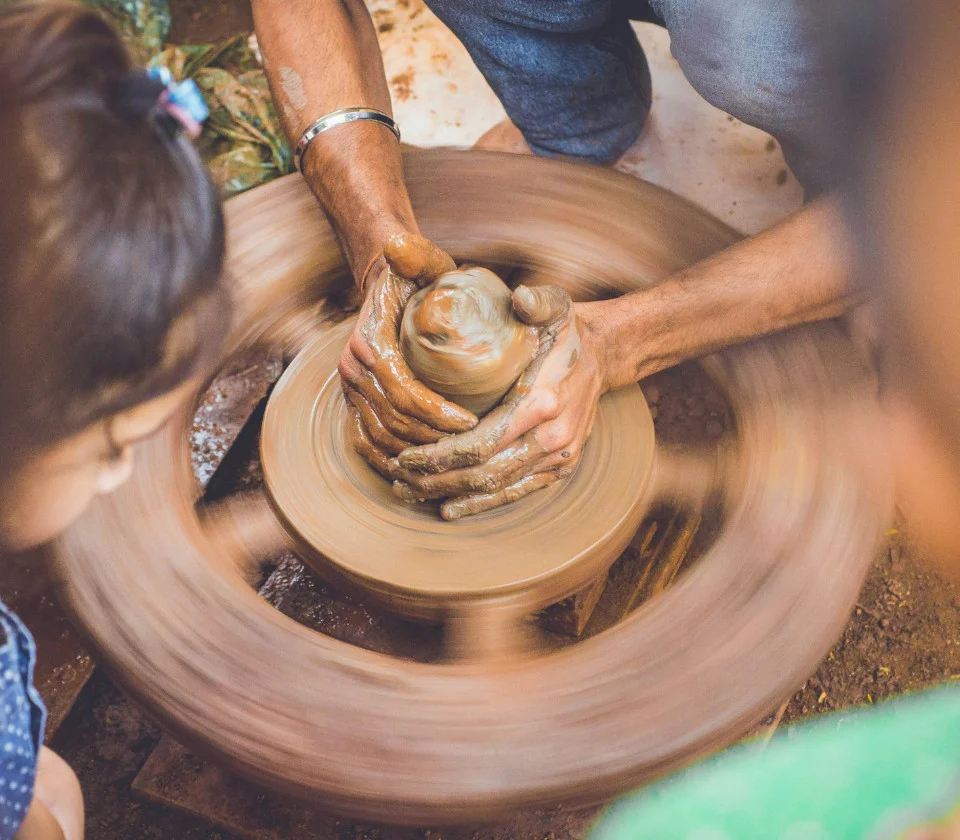
So, I went down to the potter’s house, and there he was working at his wheel. The vessel he was making of clay was spoiled in the potter’s hand, and he reworked it into another vessel, as seemed good to him.
Then, the word of God came to me: “Can I not do with you, O house of Israel, just as this potter has done? says our God. Just like the clay in the potter’s hand, so are you in my hand, O house of Israel. At one moment I may declare concerning a nation or a kingdom that I will pluck up and break down and destroy it, but if that nation, concerning which I have spoken, turns from its evil, I will change my mind about the disaster that I intended to bring on it. And, at another moment I may declare concerning a nation or a kingdom that I will build and plant it, but if it does evil in my sight, not listening to my voice, then I will change my mind about the good that I had intended to do to it. Now, therefore, say to the people of Judah and the inhabitants of Jerusalem: Thus says our God: Look, I am a potter shaping evil against you and devising a plan against you. Turn now, all of you, from your evil way, and amend your ways and your doings.”
A New Vessel
One day when I was in ceramics class, I got this idea to make a bowl that looked like it had been formed out of a mass of wild vines that had somehow grew into this sort of bird’s nest. I was kind of in this phase when I was trying to create really organic looking thing. I had just made a vase that kind of looked like a cross between flower petals and a sea shell, and I thought it came out really cool, so I was excited to see what else I could come up with. So I thought, wouldn’t it be neat to make a ceramic pot that just kind of looked like a mass of vines?
There are a few standard ways to form a vessel using clay. The one that most people would think of first would be to throw a pot on a potter’s wheel, like the one in our reading today. The potter sits in front of a flat wheel, plonks a ball of clay in the center, and the forms the clay with their hands while it spins. Nowadays, you would probably use a potter’s wheel powered by electricity, but during the time of our reading, it was most likely the potter’s own foot that was spinning the wheel.
My ceramics professor actually had a wheel like this, and anytime he demonstrated something, he had to start by kicking the pad on the bottom of his wheel that would make it spin. He always liked to say that there were no mistakes in pottery, only opportunities. One day, he threw this enormous bowl; it was probably a foot and a half tall, and just as wide. He then pressed a finger on the inside wall, while the wheel was turning pretty slowly, and by doing this he made this raised spiral on the outer surface bowl. Then, he pinched part of it, and ripped a hole in another part, and he just kept messing with it until eventually the whole thing just fell apart. And then, he just smiled and shrugged, pushed the clay back together into a ball, centered it on the wheel, and started over.
The second way to create a vessel is the slab method. As the name implies, you create slabs of clay, which should be pretty thin, about three-quarters of an inch, or less, and you join the slabs together by scoring the edges and smearing them with slip, which is basically a paste made by additional water to some clay, and then pressing the edges together. This method is good if you want to make boxes, or anything with angles, because you can’t really do that with a potter’s wheel.
The third way is the coil method, which is the method that a lot of Native Americans used to make their pottery. For this, you have to roll the clay into long thin ropes, and then you coil it into a pinwheel, kind of like a lollipop, until you have a circle that the size of the base that you want. Then, you start coiling upwards to make the walls of the vessel, kind of like if you tried to make a bowl by squeezing out a line of toothpaste around and around, building up a wall. As you go, you have to score the rope, and use slip, just like you would with the slab method, so that the ropes stick together and there’s no holes in your pot.
The method that I tried to use for my “vine nest” bowl was none of these. I thought if I could just sort of weave ropes of clay together carefully enough, it would have enough structure to hold itself up until it was dry, and then once it was fired, it would be good. There’s a reason why basket-weaving never became one of the standard ways of making a clay vessel. Clay is heavy. It’s pulverized rock mixed with water. And until you fire it to fuse all of the microscopic pieces of rock together, it’s fragile. So, when I rolled the clay into ropes and essentially tried to weave a basket out of it, the whole thing started to sag under its own weight. I stubbornly tried to save it by adding more ropes of clay, creating this massively heavy monstrosity, and I covered it so I could come back to work on it the following week, but when I got back, the ropes of clay had dried out too much, and the whole thing was too brittle, and it basically just fell apart.
Sometimes, we can’t really see how something is going, when what we’re doing isn’t going to work, so we keep pushing forward instead of trying to come up with a better way of doing it. In our reading, God uses this metaphor of a spoiled clay pot for the people of Israel. The people had become misshapen, malformed, they were a people that needed to be plucked up, overthrown, rebuilt, and replanted. Instead of placing their trust in God and following God’s law, they had opposed God through oppression, and even worshipped other gods and sought political intrigue. And because of this, they are exiled. There was more plucking up, and pulling down, and destroying, and overthrowing, as the nations opposing God’s will and standing in the way of the reshaping and the recreating of God’s people had to be dealt with. This imagery of the breaking down and the building back up of the clay pot is an apt metaphor not only for the people of God, but for the people around them. God wanted the people to reflect God’s glory. But, God didn’t create a whole new people scratch. God gathered the remnant. God pulled together what was left, what survived the destruction, the breaking down, the exile, and from that, a new nation was born.
This metaphor, this reshaping of the pot, can be used for many things. So many of us have had to endure incredible hardships in our lives, events that threatened to break us. We might even say that they did break us. But, we are still here…we are here now…because we survived…because God took those broken pieces and put them back together. We know that God can work miracles. We know that God can make something out of what looks like nothing. Our God is a God of Resurrection. Our God is a God of Rebirth. Our God is a God of Rebuilding, Reconciliation, and Second Chances. Jesus was dead, but he was brought back to life, and is alive now, a living symbol of who God is and what God can do.
With God there is always hope. With God, we can always look forward to a reshaping of the clay, no matter how mangled the vessel becomes.
It’s tempting here, as we look at our reading, to think that God is threatening to punish the people for not behaving a certain way. But, I don’t think it’s necessary to interpret this text in that way. Remember that we are hearing this second-hand from Jeremiah, and we don’t truly know the method by which this information was transmitted to him. We know there was a potter. We know that God used the potter working at their wheel as a metaphor for the people of Israel. And, we know that this information comes to us through Jeremiah, written over 2,600 years ago, passed down from his followers, through scribes and through translators. So, I feel like this gives us some leeway in how we interpret this text.
We know that certain behaviors will lead to destruction with or without God’s intervention. Neighbor turning on neighbor, selfishness and greed, tribalism and bigotry, fear-mongering and profiteering, these are all ingredients for an unsustainable society. Sure, some people may benefit in the short-term, but ultimately, this will lead to disaster, and then God will have to come in, pick up the pieces, and start over. And, the longer we wait to course correct, the more drastic the correction will need to be. When my ceramics professor collapsed his bowl back down into a lump of clay, he could immediately start working it again to make a new bowl, because the clay was still wet and malleable, still workable. But, when I finally gave up on my “vine nest” bowl, the pieces had already dried out. In order to turn it back into workable clay, the bowl need to be smashed. The pieces need to be broken up, and soaked in water for many days, until the clay was soft enough be worked back together into a uniform paste, making sure to get all of the lumps out. Then, the clay had to be rested to remove the excess water, which again, would take several days. It was a lot more work to get it back to the point where it could be used again, unlike a disappointing pot, squished back down into a ball, and then immediately set spinning, in order to try to rise up once again into something hopefully better than it was before.
There are always signs when something might be going wrong. God is still speaking. God is always speaking. Whether it’s directly to us, or through the prophets, God is always speaking. We just have to listen, and we have to be brave enough to correct our course, while we still can. And, if we can do it fast enough, then we will be like a lump of clay ready to rise up again. But, if we can’t, even if we are dead set on a course of our own destruction, God will gather the broken pieces, and push us back together. God will sit with us through the pain and the sadness, through the loss and the despair, and God will make us whole again. God will turn us back into clay, and we will rise. Amen.
~ Rev. Charles Wei

