

Christ the King Sunday
Colossians 1:11-20
May you be made strong with all the strength that comes from [God’s] glorious power, so that you may have all endurance and patience, joyfully giving thanks to the Creator, who has enabled you to share in the inheritance of the saints in the light. God has rescued us from the power of darkness and transferred us into the realm of the beloved Son, in whom we have redemption, the forgiveness of sins.
[Jesus] is the image of the invisible God, the firstborn of all creation, for in him all things in heaven and on earth were created, things visible and invisible, whether thrones or dominions or rulers or powers—all things have been created through him and for him. He himself is before all things, and in him all things hold together. [Jesus] is the head of the body, the church; the beginning, the firstborn from the dead, so that he might come to have first place in everything. For in him, all the fullness of God was pleased to dwell, and through him God was pleased to reconcile all things, whether on earth or in heaven, by making peace through the blood of the cross.
Giving Thanks
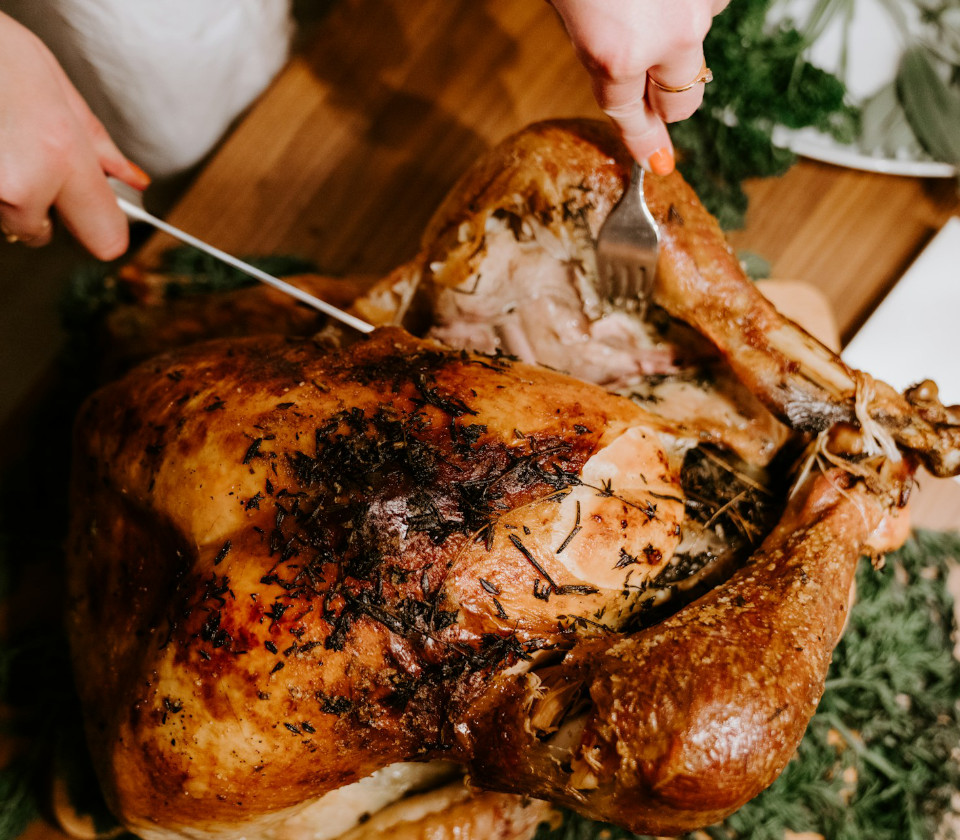
One thing that nobody ever warns you about when you first start talking about going to seminary is how your responsibilities as a member of your family will change. The minute you set foot in a seminary classroom, from that day forward, anytime there is an occasion that requires a prayer, every head will swivel towards you, and it will be assumed that you will be the one doing it. I remember that I could sense this coming the first time I came home for Thanksgiving, after I started seminary. We spent all day cooking, like every family does. We set the table, put out all the food, gravy in the gravy boats, and we gathered together.
And, my dad just looks at me and says, “Okay, Chuckie!”
I didn’t even have to ask what he wanted, because I knew. And, I knew from that day forward, whenever the family got together for Thanksgiving, it would be my responsibility to give the blessing.
As you know, I was recently visiting my family for Halloween, as I’ve done for the last three years, and since I’m not there for Thanksgiving Day, my family’s started celebrating it early while I’m still there. So, a few days before I left, my dad barbequed a turkey, I made mashed potatoes and gravy, rolls and sweet potatoes, we invited a bunch of people over, and we celebrated Thanksgiving. We got the food on the table, gathered everyone around, and that was my cue to give the blessing. I said the standard Thanksgiving Day things: that we were thankful for the food, for our family and friends, and that we should remember those who are less fortunate than us, especially all of those who would be losing their SNAP benefits. Amen.
I didn’t think I was being controversial, but after the prayer, someone told that me I was being political, and that there shouldn’t be politics in religion…because apparently praying for people to not go hungry is political now.
Our reading from the epistles today is about giving thanks, which is appropriate, since Thanksgiving is this week. But, it’s also about who Jesus is. And, who Jesus is, is someone who would pray for those who might go hungry. This text has some heavy theology in it. It talks about God’s power, salvation, that “[Jesus] is the image of the invisible God, the firstborn of all creation…all things have been created through him and for him. He…is before all things, and in him all things hold together. [Jesus] is the head of…the church; the beginning, the firstborn from the dead…For in him, all the fullness of God was pleased to dwell, and through him God was pleased to reconcile all things…through the blood of the cross.”
I have to tell you that Bible study last week was a lot more interesting than it’s been in a while because of this text. I mean, “image of the invisible God” sounds pretty self-explanatory until you just stop for a minute to think about it. And, what does it even mean that “all things have been created through him and for him?” We are talking about the very nature of Jesus the Christ, here. And, even though this text makes reference to Christ’s death on the cross, I think it’s important to remember that the sacrifice is coming, as we enter this season of waiting for this birth.
Traditionally understood as a letter written by Paul while he was in prison, we could imagine that he had a lot of time to think about and meditate on the nature of God and Jesus. “For in him, all the fullness of God was pleased to dwell, and through him God was pleased to reconcile all things…through the blood of the cross.” Those are the kinds of words that can fracture a church. As are, I suppose, praying for people who are about to lose their SNAP benefits.
We have a long tradition in this country of not talking about religion and politics, especially at the Thanksgiving Day table. But, this avoidance has only served to further divide us. We are more polarized than ever, and I think this rule of not talking about politics and religion is at least partly to blame, as we no longer have the skills to discuss these topics with people we disagree with, without the conversation becoming heated, and people becoming angry. And, heavens forbid you put these topics together.
I was asked to lead a table at the Great Conversations event, last Wednesday. The table they wanted me to lead? Politics in the pulpit. I had no idea what to expect; I had never attended one of these events before, but it sounded like fun, and the person I talked to said I didn’t actually have to be an expert on the topic, and I wasn’t giving a presentation. I was just supposed to lead the discussion and share my lived experience of preaching during a time when it seems like politics is all anyone can think about.
There were five other people at my table, and it was a really great discussion. They shared their personal experiences of being uncomfortable whenever they went to church, and pastors or priests would tell them how to vote. I wish I could say I was shocked to hear this, but I’ve actually heard worse, so it wasn’t a surprise. But, as the conversation went on, I slowly came to understand that they only disliked hearing politics from the pulpit when it was something they disagreed with. Apparently, if the politics aligned with their way of thinking, it was okay. I, of course, did point this out to them, and none of them denied it.
One comment that I found particularly interesting was that it was okay for people to be who they are, as long as they don’t upset the status quo. In other words, you can live your life in a way that’s different from mine, as long as I don’t have to do anything different in my life because of it. I didn’t say what I’m about to say, because I didn’t want to rock the boat, but it’s easy to say things like that from a place of privilege, when you’re not the one suffering because of the way things are. What I did say was that when it’s the societal norms that are oppressing people, when your way of life, your way of living, is hurting people, then we do need to speak against it.
Because, we are hurting people. Our culture is hurting people. And yes, talking about it can make some people uncomfortable. But, if my comfort comes to me as a result of someone else’s pain, I want to know about it. And, I bet a lot of you would want to know about it, too. This is why “Do unto others as you would have them do unto you” is the Golden Rule. This is why Jesus was always telling us to love our neighbors, to feed the hungry, to give to the poor. Doing these things can make us uncomfortable. We often have to make some kind sacrifice to do these things. But, we live in a fundamentally unfair system, which many of us benefit from. And, the very nature of God, the very nature of He who is the image of the invisible God, is to care about the less fortunate.
I talked about God’s preferential option for the poor a few years ago, but I think this is as good a time as any for a refresher. God’s preferential option for the poor is a theological principle about how God stands in solidarity with the poor and the powerless. If we pay attention to what God, and Jesus, and the prophets say throughout the Bible, there is a clear pattern of preference given to the poor and the powerless. Deuteronomy 15:11 says, “You shall freely open your hand to your brother, to your needy, and the poor in your land.” Proverbs 21:13 says “They who shut their ear to the cry of the poor will also cry and not be answered.” Luke 14:13 says “When you give a reception, invite the poor, the crippled, the lame, the blind.” The list goes on and on and on. So, is Jesus the kind of person who would pray for people who are going to lose their SNAP benefits? Yes, he is.
We have a lot to be thankful for, this Thanksgiving. We have this beautiful community, here at Plymouth. I feel so much love and support anytime I’m with you, and I know it’s the same for you. I often have to take a step back just to take it all in, to remind myself that this is real…that I did indeed move to Montana, a place that I never thought about moving to. And, I ended up with a congregation that was more loving and kind than I could have ever hoped for. Most of us will be spending our Thanksgivings with family and friends. The tables will be bountiful. The conversation and the laughter will be joyous and loud. Our bellies will be full, and our sleep will be warm and peaceful. And, while it is good and right to enjoys these things, and to be thankful for these things, we must always remember those who will not be experiencing the same Thanksgiving that we will be. We must be compassionate and generous, and some cases, forgiving. Because, no matter the circumstance, all people are God’s people, and we have been tasked to love them. So, celebrate and give thanks, and remember and give. Amen.
~ Rev. Charles Wei

